
The short version
- A dock usually answers to federal, state and local offices.
- The Corps of Engineers requires authorization for structures in navigable water, including small floating docks.
- Minor work is often covered by a general permit; bigger or unusual docks need individual review.
- State and local size limits vary widely, so find yours before you design.
- Changing an existing dock's design needs approval too.
General information only. Codes, ordinances and agency procedures change and vary by locality. Confirm current requirements with the offices named below before you design, apply or build.
Why a dock is different from a deck
A deck sits on your lot. A dock leaves it and reaches out over water that other people boat on, fish in and, in many places, that the public owns. That is why a dock usually answers to three levels of government, where a deck answers to one.
The federal layer
The U.S. Army Corps of Engineers explains that Section 10 of the Rivers and Harbors Act of 1899 requires its authorization "for the construction of any structure in or over any navigable water of the United States," and that the law "applies to all structures, from the smallest floating dock to the largest commercial undertaking" (USACE).
Navigable waters, in the Corps' words, are those "subject to the ebb and flow of the tide" or that are, have been or could be used to carry interstate or foreign commerce. Its examples of work needing a Section 10 permit include piers, floats, boat lifts and jet ski lifts (USACE).
That does not mean every backyard dock goes through a long federal review. The Corps says its general permits "authorize minor activities without the need for individual processing," and that an individual permit may be required when a general permit does not apply (USACE). Which one covers a private dock depends on the district and the design.
The state layer
The Corps is clear that its permit is not the only one: "Permits, licenses, or similar authorizations may also be required by other federal, state, and local agencies" (USACE).
State rules vary more than anything else in this guide. Depending on where you are, the bed of the waterway may belong to the state, a lake may be run by a power company or water authority, and there may be fixed limits on how wide a pier can be, how large a platform can be, and how far a dock may reach from shore. Some states route one joint application to every agency involved; others want separate filings.
The local layer
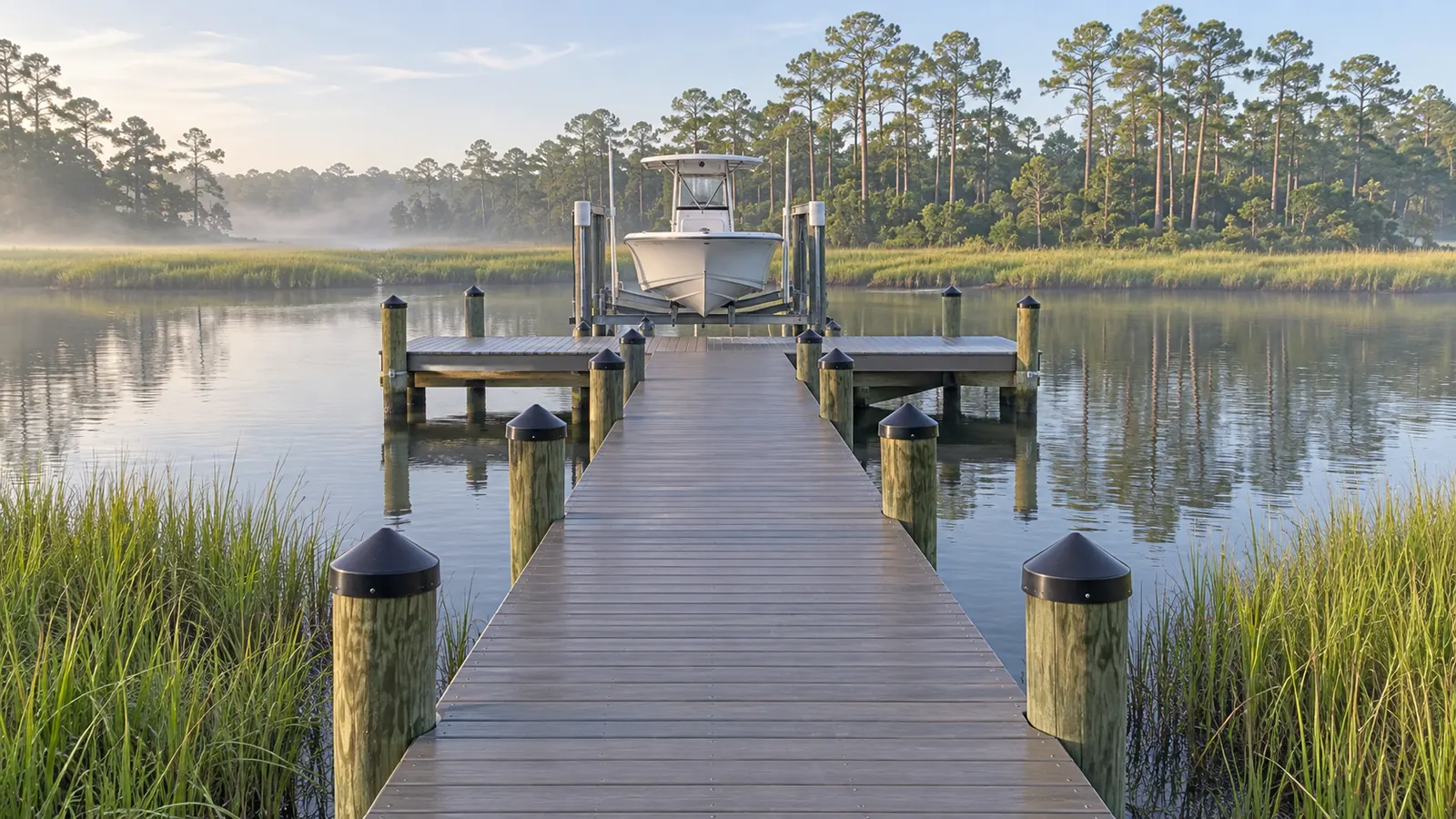
Your city or county can require a building permit for the structure and often has its own say on setbacks from side property lines, lighting, roofs and work in wetlands. A dock that crosses marsh is designed with that in mind: high enough and narrow enough to let light reach the grass underneath. Homeowners' and lake associations may add rules of their own.
How long it takes
Allow for it early, because approvals can take longer than the build. As one yardstick, one Corps district says its goal is a decision within 60 days of a complete application for general permits and 120 days for individual permits, with several listed exceptions (USACE). State and local reviews run on their own clocks. The Corps also recommends getting in touch early: "When in doubt as to whether a planned activity requires a permit," contact the district office.
Repairs and rebuilds
Replacing worn decking is one thing; changing the dock is another. The Corps lists "constructing, replacing, or repairing" piers, docks and pilings among regulated activities, and says that "rebuilding a structure that deviates from the previous design would require" its authorization (USACE). Ask before you lengthen, widen or move anything.
A sensible order of work
- Survey and soundings. Establish property lines, the shoreline and depths along the proposed dock.
- Find the limits. Ask the state and local offices what size and reach are allowed on your water.
- Design inside them, unless you intend to seek a fuller review.
- Talk to the neighbors. Objections slow things down, and good relations help everywhere else.
- File the applications with drawings: federal, state and local, jointly where the state allows it.
- Build to the approved drawings.
We prepare the drawings and help with the applications as part of a dock build.