
The short version
- Fixed piers stay put; floating docks rise and fall with the water.
- A small swing in water level suits a fixed pier; a big one favors floats.
- Floats suit kayaks, small boats and easy boarding, in water deep enough at low tide.
- Many docks combine both, within whatever platform limits apply.
Two ways to stand over water
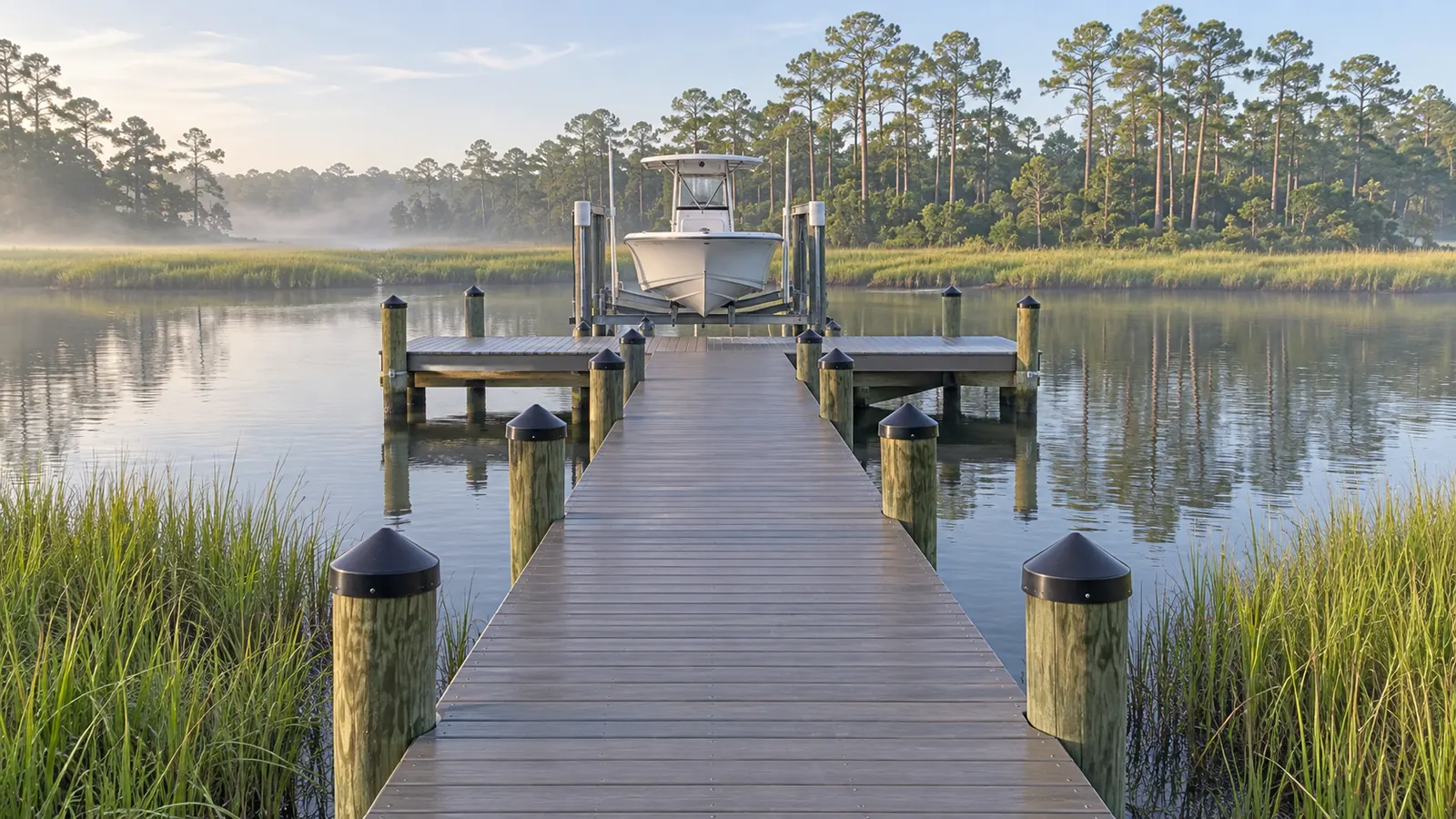
A fixed pier stands on pilings driven into the bottom. Its deck stays at one height and the water moves beneath it. A floating dock sits on floats and rides up and down with the tide, held in place by guide piles or anchors and reached by a hinged gangway.
Start with your tide
The bigger the swing in water level, the stronger the case for floats. On the coast, NOAA publishes a mean range of tide for each of its stations, the difference in height between mean high water and mean low water (NOAA Tides & Currents). Where that range is a couple of feet, a fixed pier set at a sensible height puts the deck a comfortable step above most boats through the whole cycle. Where it is several feet, or where a lake is drawn down seasonally, a float keeps boarding easy.
Wind matters as much as the tide tables. A strong onshore wind can push water well above the predicted level, and a hard offshore blow can drain a shallow creek. Design for the water you actually get.
| Fixed pier | Floating dock | |
|---|---|---|
| Height above water | Changes with the tide | Constant |
| Feel underfoot | Solid | Moves with wakes and waves |
| Boarding small craft | Needs a ladder or step-down at low water | Easy at any tide |
| Boat lifts | Mount naturally on the pilings | Need their own pilings or a floating lift |
| Shallow water at low tide | Unaffected | Floats can ground, which strains them |
| Storm surge | Deck can be overtopped | Rides up, if guide piles are tall enough |
| Upkeep | Pilings, hardware, decking | All of that, plus floats, hinges and pile guides |
When a fixed pier is the answer
- You are crossing marsh or shallows to reach deeper water.
- You want a boat lift.
- The site sees regular wakes or chop, and you want a steady platform.
- The water at the end of the pier gets thin at low tide.
When floats earn their keep
- You keep kayaks, paddleboards, a skiff or a personal watercraft and want to step on and off at water level.
- Older or less steady passengers need easy boarding.
- The water is deep enough at low tide that the floats never touch bottom.
- The spot is sheltered from long fetch and heavy wakes.
A common answer: both
Many docks pair a fixed walkway with a small floating platform at the end or alongside. The walkway crosses the shallows and carries the lift. The float handles the kayaks and the swim ladder.
If you go that way, check how your state and locality count platform area. Some set one total for pier-head platforms and floats together, so a generous pier head can leave less room for a float. Floats and lifts are also on the Corps of Engineers' list of work that needs authorization (USACE). Our dock permit guide explains who to ask.
Questions to bring to the site visit
- How deep is the water at the end of the proposed pier at a low tide?
- What is the bottom: sand, mud, or shell?
- What boat, and how do you get on and off it now?
- Which way does the weather come from, and how much wake passes?
- What have neighbors on the same creek built, and how has it held up?
We take soundings and look at all five on a dock site visit. The permit guide covers the paperwork.