
Docks and piers
Docks and piers, built for your water
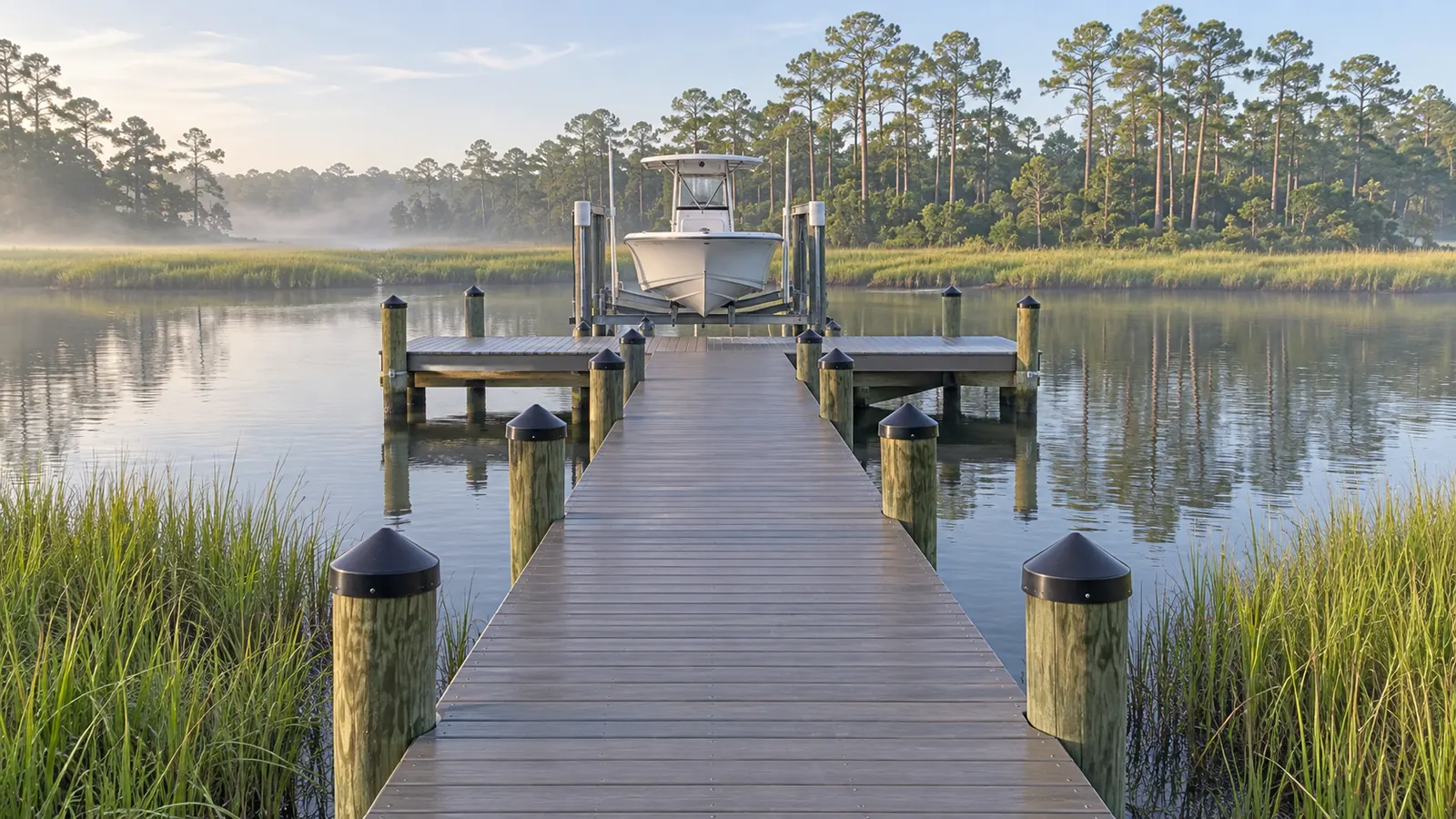
Private piers, platforms, floating docks and boat lifts designed around your shoreline, your water and your boat, with the permit drawings to match.
What we build
A dock that fits your water
No two shorelines are alike. Depth at low water, the bottom, how far the shallows run, what the neighbors have built and what boat you keep all shape the design. We start with those, then draw a dock that works on your lot.
- Fixed timber piers and walkways
- L-head and T-head platforms
- Floating docks and gangways
- Boat lifts and lift-ready slips
- Kayak and paddleboard launches
- Ladders, cleats, bumpers, benches and fish-cleaning stations
For the trade-offs between a fixed pier and a floating dock, see fixed vs. floating.
What drives the price
- Length. How far you have to go to reach usable water when the level is low.
- Pilings. How many, how long, and how hard they are to drive.
- Platform size. The pier head and any floating sections.
- Decking. Treated wood, composite or PVC.
- Lift and power. Boat lifts, lighting and shore power.
- Access. Whether materials arrive by land or by barge.
The rules
Three offices with a say over your dock
A dock leaves your lot and reaches over water other people use, so it usually answers to more than the local building department.
Federal
The U.S. Army Corps of Engineers requires authorization for any structure in or over navigable water, and says the law applies to all structures, "from the smallest floating dock to the largest commercial undertaking" (USACE).
State
The Corps notes that permits or licenses "may also be required by other federal, state, and local agencies" (USACE). State coastal, natural resources or lake agencies commonly set limits on pier width, length and platform size.
Local
City or county building permits, zoning setbacks from side property lines, wetlands or shoreline boards, and any homeowners' or lake association rules.
The limits differ from one shoreline to the next, so we check what applies to yours before drawing anything. Our dock permit guide walks through the process.
How we build them
Materials picked for life in the water
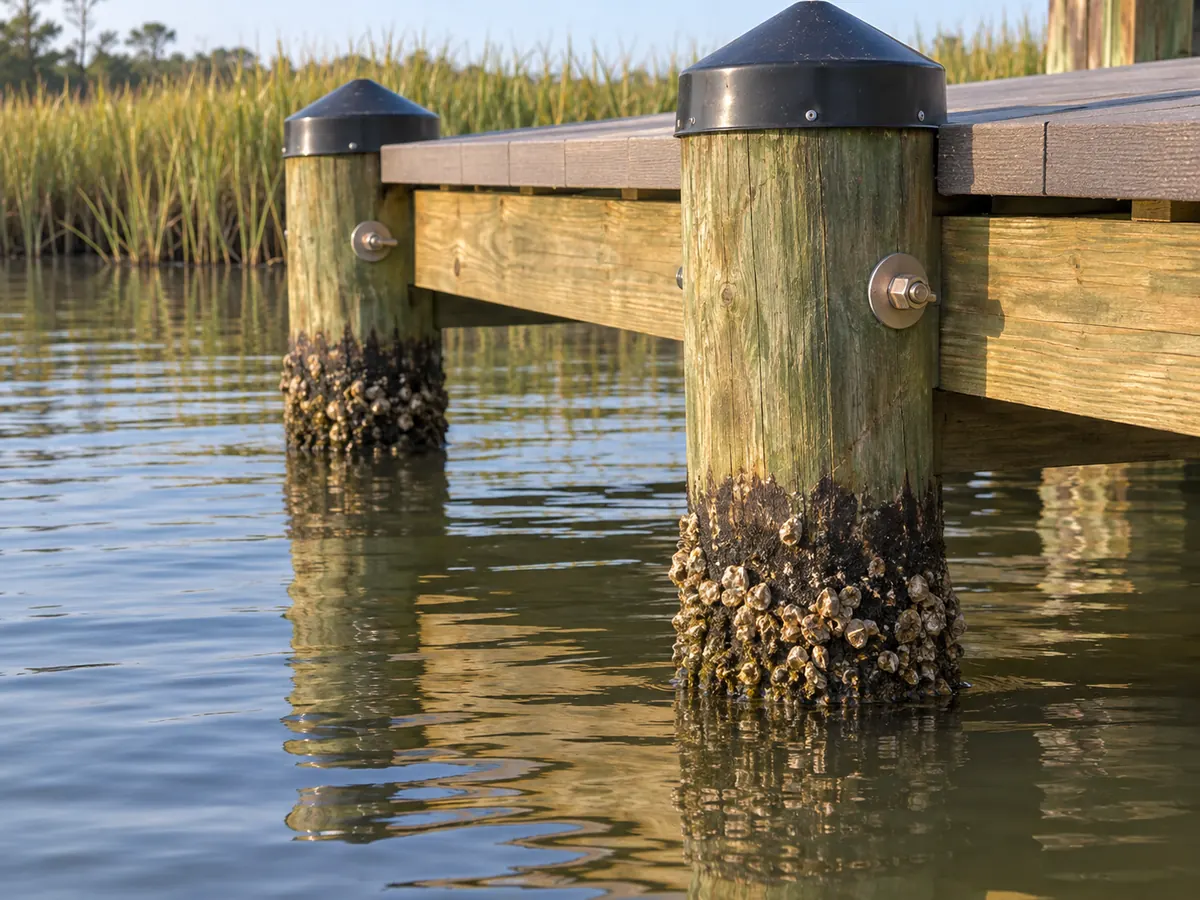
- Pilings treated for your water. The AWPA standard puts piling in salt or brackish water in its marine use categories, UC5A to UC5C depending on the coast, and fresh water piling in UC4C (AWPA U1).
- Stainless fasteners. FEMA's coastal bulletin recommends Type 304 or 316 stainless, with 316 the more corrosion resistant (FEMA TB 8).
- Decking that tolerates a soaking. Trex says its boards are approved for all water-contact applications and should be installed with stainless fasteners (Trex FAQ). Treated wood remains the traditional choice.
- Height set from your high water. On tidal sites we work from published tide data, such as the mean high water and mean range that NOAA lists for its stations (NOAA); on lakes and rivers, from recorded levels. Then we add room to spare.
- Piling caps. Caps keep rain out of the end grain, where rot starts.
Paperwork
Applications and drawings
Dock applications are judged on drawings. Reviewers want to see where the dock sits on the lot, how far it reaches, how wide it is, and how deep the water is along its length.
Among the work the Corps of Engineers lists as needing authorization are piers, floats, boat lifts and jet ski lifts (USACE), so lifts and floating sections belong on the same set of drawings as the pier itself.
How we help
- Site measurements and depth soundings for the drawings
- Plan and section drawings for the application
- Help completing the permit applications
- Building to the approved drawings, not to a guess
Do I need a permit to build a dock?
Can my dock have a boat lift or a roof?
Often, but each is reviewed. Boat lifts and jet ski lifts appear on the Corps of Engineers' list of work that needs authorization (USACE), and many states and localities limit the size of roofs and covered slips. We check the rules for your shoreline before pricing either.
How long should my pier be?
Long enough to reach the depth your boat needs at low water, and no longer than the rules for your shoreline allow. We take soundings on the site visit so the length is based on your water.
Composite or wood decking on a dock?
Both work. Treated wood costs less and needs upkeep. Composite costs more, needs washing only, and Trex states its boards are approved for water-contact applications when fastened with stainless steel (Trex FAQ). See dock materials for salt water.
Common questions
Docks and piers: quick answers
More on quotes, permits and materials in the full FAQ.
Read the full FAQFrom the Field Guide
Worth reading before you decide
Dock and pier permits, in plain English
Why a dock answers to federal, state and local offices, and how to line the approvals up.
DocksFixed pier or floating dock?
How tide range, water depth, boat type and budget point to one or the other, or a mix.
DocksDock materials that survive salt water
Pilings, framing lumber, decking and the fasteners that hold up around salt water.
Thinking about a dock?
Tell us about your shoreline and your boat. We will visit, take soundings and send a written quote.