The short version
- Docks face three exposure zones: submerged, tidal and splash.
- Pilings in salt or brackish water call for marine-category treatment (AWPA UC5A to UC5C, by coast).
- Use stainless fasteners, Type 316 where possible, and never mix metals.
- Composite decking is approved for water contact but still needs a treated frame.
Three zones, three sets of problems
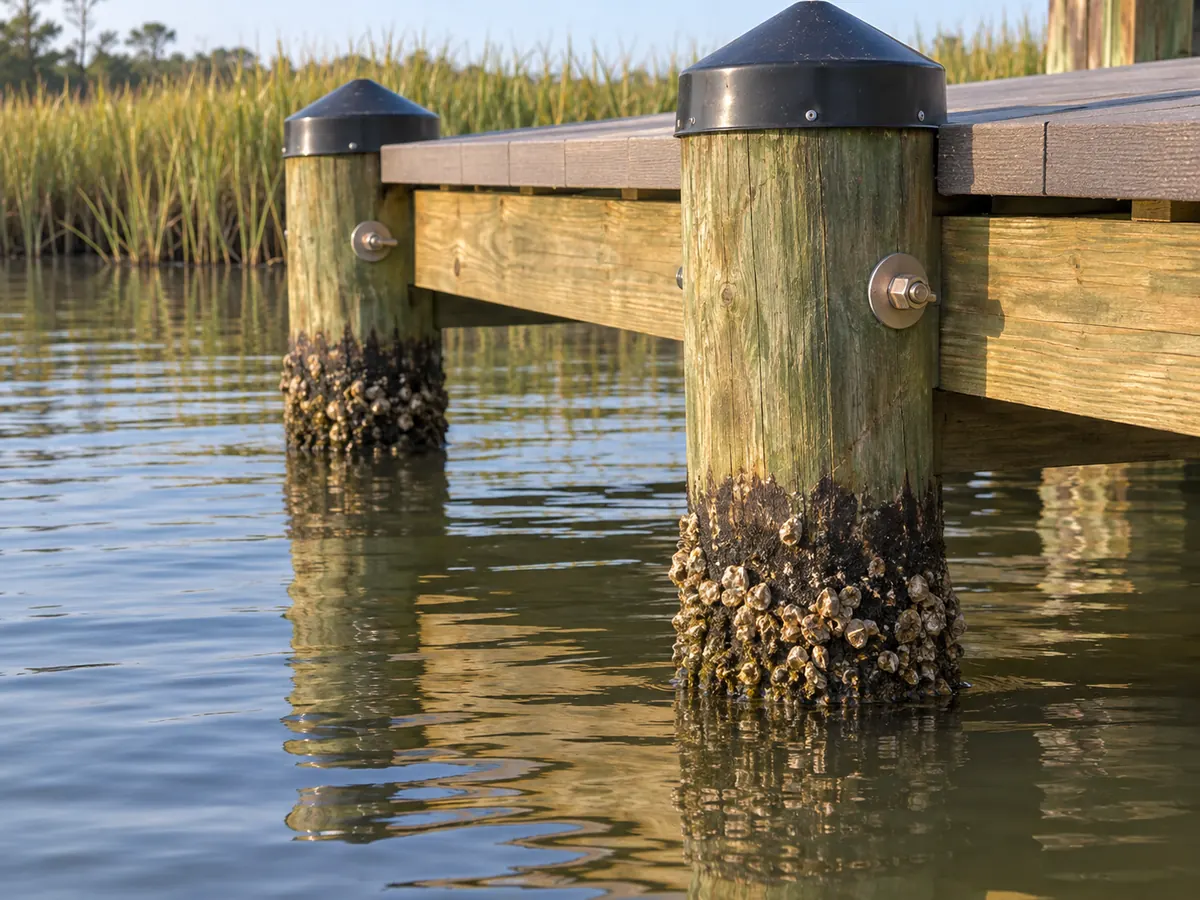
A dock lives in three environments at once. Below low water, timber is permanently wet and exposed to marine organisms. Between low and high water it is soaked and dried twice a day. Above high water it gets sun, rain and salt spray. Each zone asks something different of the materials.
On tidal water, the size of that middle band is the tide range. NOAA publishes it for each of its tide stations as the mean range of tide, "the difference in height between mean high water and mean low water" (NOAA Tides & Currents). On lakes and rivers the band is set by seasonal levels and boat wake. Either way, it is where most deterioration shows first.
Pilings and submerged timber
Treated lumber is classified by where it will serve. In the American Wood Protection Association's system, marine exposure is its own tier, split by coastline: UC5A for northern waters, UC5B for central waters and UC5C for southern waters, including the Gulf coast. The marine categories cover wood exposed to salt and brackish water, and specifically include "piling and bracing, bulk-heading or other construction that is actually exposed at some time during the year to salt water" (AWPA Standard U1).
The reason is marine borers. The standard defines its marine categories by which wood-boring organisms are present along each stretch of coast, so the right treatment depends on where the dock stands. Fresh water is a different case: the standard places land and fresh water piling in UC4C, and joists and beams for freshwater docks in UC4A (AWPA Standard U1).
What to ask for: pilings and any member that touches the water treated to the use category for your water, with the treatment tag left on for the inspector.
Framing above the water
Stringers, headers and bracing above high water are in the splash zone. The AWPA places wood used in salt water splash zones in UC4B, its heavy-duty ground contact category. Ordinary above-ground deck lumber is not treated for that exposure.
Fasteners and connectors
Metal is the weak link on most docks. FEMA's coastal bulletin recommends stainless steel in Type 304 or Type 316, adding that "Type 316 is more resistant to corrosion and should be used for stainless steel metal connectors" (FEMA TB 8). It also warns that:
- fasteners and connectors must be of similar metals, because mixing them causes galvanic corrosion that "can dramatically reduce" the life of the weaker metal;
- the chemicals in treated wood contribute to corrosion alongside salt spray; and
- heavier galvanizing such as G185 carries two to three times the zinc of standard G60 or G90 hardware.
On a dock, that means stainless through-bolts, washers, screws and hangers, bought as a matching set.
Decking
Pressure-treated pine is the traditional choice: inexpensive, structural and easy to replace board by board. It needs upkeep and will eventually splinter.
Composite works on docks as well as decks. Trex states that its decking "is approved for all water-contact applications," that boards "can be submerged in water for extended periods of time, including multiple times a day with rising tides," and that stainless steel fasteners should be used (Trex FAQ). Because composite is not structural, stringer spacing has to suit it.
PVC contains no wood fiber and is unaffected by moisture, at a higher price.
Whatever the board, leave consistent gaps. Gaps let surge and wave energy pass through instead of lifting the deck.
Small parts that pay for themselves
- Piling caps shed rain from the end grain.
- Piling wraps can slow further loss on pilings that are still sound.
- Sacrificial bumpers and rub rails take the wear from boats so the structure does not.
For more on how these fit together, see docks and piers and dock repairs.