
Dock repairs
Dock repairs, before small becomes big
Pilings, framing, hardware and decking put right by people who work on the water. A dock that moves, rusts or splinters is telling you something.
Warning signs
Six signs a dock needs attention
Walk your dock at low water a couple of times a year, and after every big storm. These are the things worth acting on.
Movement
Sway or bounce you can feel when you walk or when a boat pulls on its lines. Usually bracing, bolts or a piling.
Necked pilings
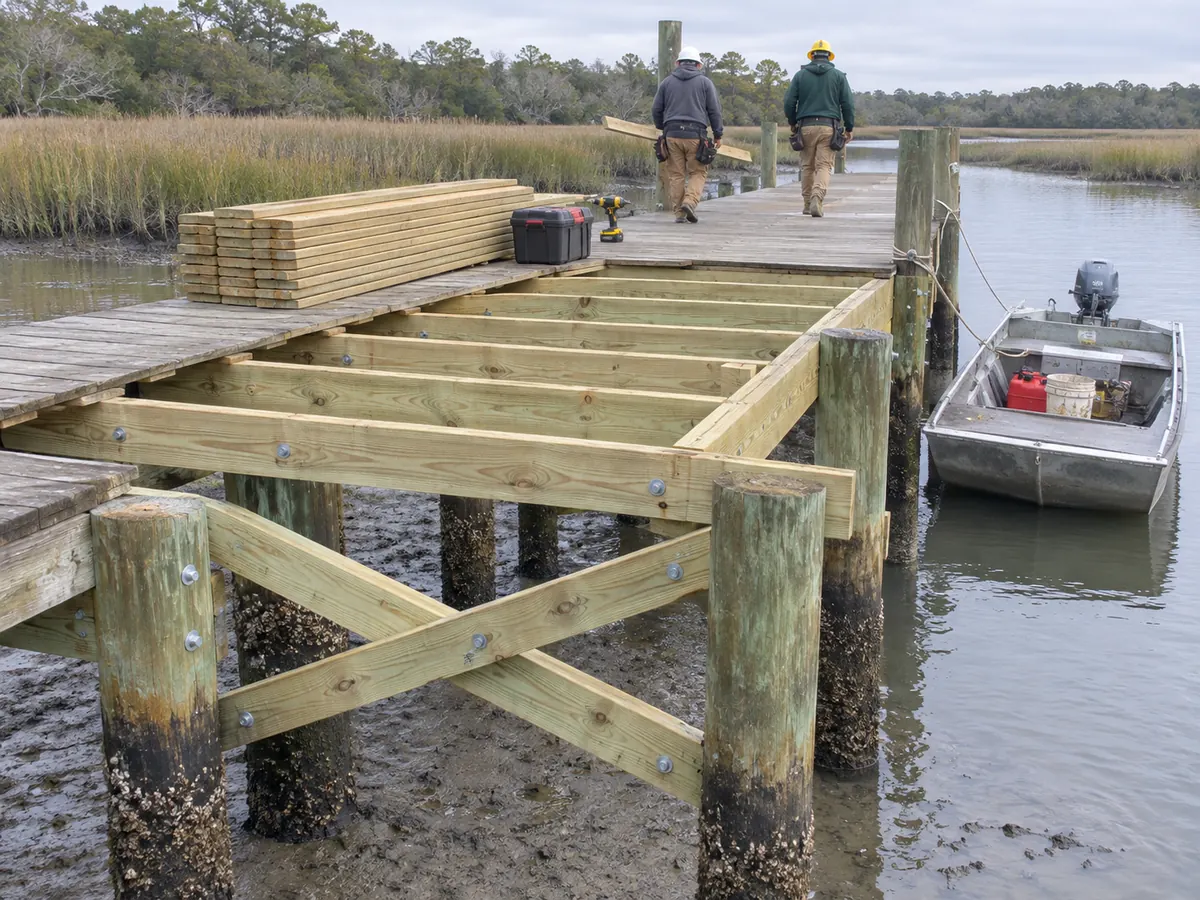
A piling that narrows between the high and low water lines has lost section to rot or marine borers and may need replacing.
Rust streaks
Orange stains under bolts and hangers mean the hardware is corroding. Hardware fails long before the timber does.
Soft or split boards
Boards that flex, cup, split at the screws or feel spongy underfoot.
Lifted or leaning sections
Pilings pushed up or tilted by ice, surge or a boat strike, and decking that no longer sits level.
Loose attachments
Wobbly ladders, cleats that turn, handrails that move, and lift beams that have shifted.
If a piling or the main framing looks compromised, stay off the dock and keep boats from loading it until it has been inspected.
What we fix
Repairs, from the mud up
- Pilings. Replacement, sistering, wraps and new caps
- Framing. Stringers, headers and cross-bracing
- Hardware. Corroded bolts, hangers and brackets swapped for stainless or heavy galvanized
- Decking. Individual boards or a full re-deck in wood or composite
- Floating docks. Floats, hinges, pile guides and gangways
- Attachments. Ladders, cleats, bumpers, handrails and lift bunks
Where the pilings and framing are sound, re-decking a dock works the same way as resurfacing a deck: new boards on the structure you already have.
Why docks wear out
What the water does to a dock
Corrosion. FEMA's coastal bulletin explains that salt spray and the preservatives used to treat wood both contribute to corrosion of metal fasteners, and that some newer preservative formulations are more corrosive to connectors than the ones they replaced (FEMA TB 8). It is why we replace like with better, not like with like.
The wet-dry zone. The stretch of piling between low and high water is soaked and dried over and over, with every tide on the coast and every change of level on a lake or river. Rot and marine growth concentrate there.
Marine borers. Wood-boring organisms live in salt and brackish water, and the wood-treatment standard defines its marine use categories by which borers are present along each stretch of coast (AWPA U1). Piling treated for fresh water does not last in salt water.
Storms. Surge lifts decking from below and loads pilings sideways. See our storm prep checklist.
Repair or rebuild?
Repair usually makes sense when most pilings are sound and the problems are in decking, hardware or a few framing members.
Rebuilding becomes the better value when several pilings have lost section, the dock has racked out of square, or the layout no longer suits your boat.
Like-for-like repairs to an existing dock and changes to its footprint are treated differently by regulators. Check before enlarging or relocating anything; we can help you ask the right office.
Request a dock inspectionCan you replace one piling without rebuilding the dock?
Usually, yes. The framing is supported temporarily, the bad piling is pulled or cut off and a new one is driven beside or in place of it, then the framing is bolted back.
Do dock repairs need a permit?
It depends on the work and the location. The Corps of Engineers lists constructing, replacing or repairing piers, docks and pilings among regulated activities, and says rebuilding a structure to a different design needs its authorization (USACE). State and local rules vary. We check with the relevant offices before starting anything beyond routine maintenance.
Can you switch my dock from wood to composite decking?
Yes, if the stringer spacing suits composite boards or can be adjusted. Trex states that its decking is approved for water-contact applications and should be installed with stainless fasteners (Trex FAQ).
How soon can you look at storm damage?
Send the details through the quote form, set the timeline to as soon as possible, and tell us in the notes if the dock is unsafe or at risk of further damage so we can treat it as urgent.
Common questions
Dock repairs: quick answers
More on quotes, permits and materials in the full FAQ.
Read the full FAQFrom the Field Guide
Worth reading before you decide
Dock materials that survive salt water
Pilings, framing lumber, decking and the fasteners that hold up around salt water.
DocksStorm prep for docks and waterfront decks
A practical checklist for the days before a big storm or hurricane, and for the walk-around afterwards.
DocksFixed pier or floating dock?
How tide range, water depth, boat type and budget point to one or the other, or a mix.
Dock not feeling right?
Describe what you are seeing and send it over. We will inspect it and tell you what it needs.