
The short version
- Resurfacing keeps the frame and replaces boards and rails, so the frame has to pass inspection first.
- Decayed or cracked framing must be replaced, and rusted hardware should be too.
- Joists wider than 16 inches apart can usually be fixed by adding joists.
- Movement, rot in posts or the ledger, or a new layout all point to a rebuild.
Why the frame decides everything
A deck has two parts with very different lives. The boards and railings sit in the weather and take the foot traffic. The posts, beams and joists sit underneath, shaded and mostly dry. On many decks the surface is worn out while the frame is still sound.
Resurfacing replaces the first part and keeps the second. It only makes sense if the second part deserves keeping.
The 5-question deck checker
Answer all five for a rough steer. It is a conversation starter, not an inspection.
The checks behind the questions
Soft spots
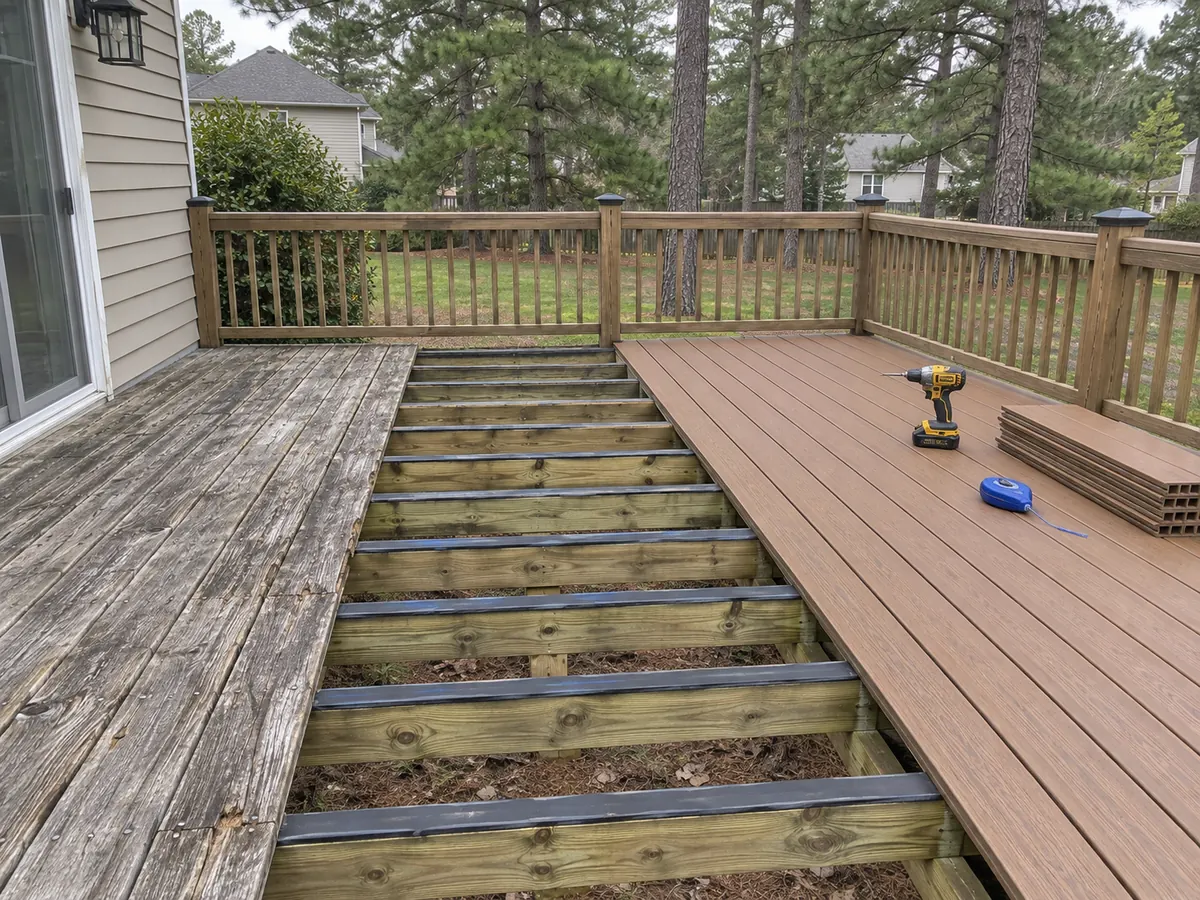
Trex's resurfacing guide describes the test: probe the wood with a flat-head screwdriver, and "if the screwdriver digs into the wood, you've found a soft spot." It goes on to say that all decayed or rotting framing, and cracked framing, has to be replaced before new boards are installed (Trex Academy). One bad joist is a repair. Rot in posts, beams or the ledger is a different conversation.
Rusted hardware
The same guide treats even a small amount of orange, brown or red rust on framing hardware as cause for concern and a reason to replace it. Hangers and bolts can be swapped during a resurfacing job, and near salt water the replacements should be stainless.
The ledger
Where a deck hangs off the house, the ledger board carries half the load. The American Wood Council's deck guide calls for corrosion-resistant flashing at that joint and half-inch lag screws or bolts with washers (AWC DCA 6). A ledger that is nailed on, unflashed, or showing a gap needs to be put right first, and sometimes that means rebuilding.
Joist spacing
Composite boards are more flexible than wood. Trex says joists should generally be no more than 16 inches on center, and that where existing joists are at 24 inches, adding one new joist between each pair is a simple fix (Trex Academy).
When replacing is the better money
- Rot in the structure. Soft posts at ground level, a decayed beam or a failing ledger.
- Movement. A deck that sways or sags has a structural problem that boards will not cure.
- Undersized framing. Older decks were not always built to today's spans and connections.
- You want a different deck. A bigger footprint, a new height or a new shape means new framing.
What to do next
Use the checker as a first pass, then have the frame inspected in person. A proper inspection lifts a few boards and looks at the places a homeowner cannot easily reach. See how a resurfacing job runs, or ask for a quote.